

How And When To Use Bear Spray
How and When to Use Bear Spray (Before You Need It)
The following is based on my independent, informal investigation. I have never personally encountered a bear, at any campsite. I feel like there’s nothing quite like hiking deep into the backcountry, surrounded by towering trees and crisp mountain air. But I suppose that feeling can quickly turn to sheer terror if you stumble upon one of America’s most iconic predators, a bear. While bear encounters are relatively rare, being prepared is the difference between a great story to tell around the campfire and a life threatening emergency. You’ll also never know, if the bear will return.
When it comes to self defense in bear country, firearms are often debated by older veterans, but wildlife biologists and conservation officers overwhelmingly agree. They say that bear spray is a veterans most effective line of defense. However, carrying it isn’t enough. Retired veterans need to know when to deploy it and how to use it effectively.
Part 1: When to Use Bear Spray (Timing is Everything)
Knowing when to spray is just as important as knowing how. Spray too early, and you’ll waste your limited supply. Spray too late, and the bear may already be on top of you.
A. Know the Difference Between Behaviors
Curious or Non-Threatening Bear: If a bear is simply wandering around, eating berries, or ignoring you, do not spray. Give it space, make yourself look large, and slowly back away. If you surprise a mother with cubs, or stumble upon a bear feeding on a carcass, the bear will likely view you as a threat. It may huff, jaw-pop, lay its ears back, make ground-slaps, or perform a mock charge (running at you and stopping short). Stand your ground and prepare your spray. If the mock charge turns into a real attack, spray. If a bear is actively stalking you, following you for a long distance, or approaching you while circling around, it may view you as prey. Prepare your spray immediately, and be ready to fight back if it attacks.
B. The Golden Rule: Wait for the Sweet Spot
Do not empty your canister when a bear is 100 feet away; the wind might blow the mist back into your face, or the bear might veer off on its own. The ideal distance to discharge bear spray is between 30 and 40 feet (approx. 9–12 meters). Bear spray aerosols form a dense cloud designed to hit the bear right in this window, blinding it, irritating its respiratory tract, and stopping its momentum.
Part 2: How to Use Bear Spray (Step-by-Step)
If a charging bear is bearing down on you at 35 miles per hour, you have about two to three seconds to react. Muscle memory is everything.
A: Keep it Accessible (No, really)
Veteran hikers with bear spray buried deep inside their backpacks. This is useless. If a bear charges, you will not have time to unzip your bag. Wear bear spray in an exterior hip holster or chest harness. Make sure it is within reach of your dominant hand.
B: Remove the Safety Clip
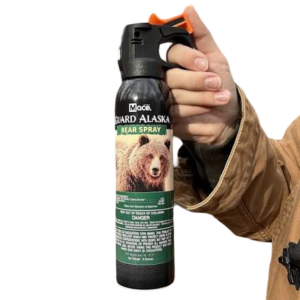
Most bear spray canisters have a safety clip (often a glowing neon orange or yellow wedge) over the trigger. Use your thumb to flick or pull the safety clip off.
Practice doing this with your eyes closed so you can do it purely by feel under high stress conditions.
C: Take a Firm Grip and Aim Downward
Hold the canister with both hands if you have time (dominant hand on the trigger, non-dominant hand supporting the base), or one-handed if you are moving quickly. Aim slightly downward. Do not aim straight at the bear’s eyes like a squirt gun. The spray needs to create a wall between you and the bear. Aiming downward ensures the cloud rises into the bear’s face as it charges forward.
D: Create a “Wall of Fog” and Press the Trigger
Depress the trigger firmly. Spray in a slight side-to-side sweeping motion to create a dense fog barrier. A standard canister will empty in about 6 to 8 seconds. Don’t waste it all at once. Give a 1-to-2-second burst. If the bear keeps coming through the cloud, hit it with another burst.
E: Move Sideways and Escape
Bear spray stops the bear; it does not instantly teleport it away. Once the bear veers off or stops, do not run (running can trigger its predatory chase instinct). Back away slowly, keeping your eyes on the animal and move out of the area.
Part 3: Golden Rules of Bear Spray Safety
Never spray gear or tents: People sometimes spray their tents or backpacks as a “deterrent.” When bear spray dries, it leaves behind an oily residue that actually attracts bears with its food like scent. Check the expiration date because bear spray loses pressure over time. Check the date printed on the canister before every hiking season.
Know the wind: Always be aware of wind direction. If it’s howling directly into your face, a charging bear is still your priority, but be prepared for blowback. If possible, angle your spray slightly crosswind.
Never store it in a hot car: Pressurized canisters can explode if left in direct sunlight on a dashboard on a hot summer day.
Final Thoughts
Carrying bear spray is a badge of honor for the responsible outdoorsperson. It proves that you respect wildlife and want to share the wilderness safely. By keeping your spray accessible, staying calm, and knowing the moment to deploy, you can enjoy the backcountry. Have you had encounters? Let me know, and stay safe.