

Arizona Campsite Stories For Hearing And Vision Impaired Veterans
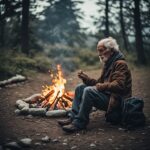
The Lonely Camper Who Cries Every Morning
The First Light
The forest at dawn did not wake with a song; it woke with a sigh. Mist rolled low over the damp pine needles, clinging to the canvas of a faded green tent pitched in a clearing too small to be grand, too large to feel safe. Inside the tent, Arthur lay on his side, his eyes wide open, staring at the nylon wall inches from his nose. Outside, the world was turning from charcoal to a bruising, bruised blue. He didn’t want to move. If he didn’t move, the morning couldn’t start.
Arthur was forty two, though in the mirror he looked like a map of a country that had lost its wars. He had come to the foothills of the Cascades to find himself, or perhaps to lose himself entirely the self-help books were hazy on the distinction. But as the first beam of pale, indifferent sunlight pierced the canopy and hit the zipper of his sleeping bag, the familiar, tight coil began to wind in his chest.
It started behind his eyes, a dry, stinging pressure. He squeezed them shut, gripping the edges of his foam sleeping pad. Not yet, he told the silence. Just wait until the coffee is on. He couldn’t wait. A single tear broke free, tracking a hot path down his cold, stubbled cheek, catching in the corner of his mouth. It tasted of salt and the stale air of a man who hadn’t spoken to another human being in nine days. Arthur pulled his knees to his chest, buried his face in the crook of his flannel-clad arm, and let the quiet, ugly weeping take him, just like it did every single day.
By the time the sun had cleared the ridge, Arthur was sitting on a weathered stump outside the tent. His face was washed in the cold creek water, leaving his skin blotchy and his eyes red rimmed the permanent morning signature of his grief. He fed twigs into the wood burning stove. The smoke curled lazily, smelling of damp cedar and resin. In the grand tradition of camping, mornings were supposed to be magical. The guidebooks promised crisp air, the aroma of roasted beans, and a sense of profound peace. Instead, Arthur felt hollowed out, like a rotting log hosting only beetles.
He held his titanium mug with both hands, staring into the black coffee. He wasn’t crying anymore, the tears had run dry around six fifteen, leaving behind only a dull, throbbing ache in his sinuses. He looked across the clearing at his empty passenger seat, metaphorically speaking. There was no one there. There was no one back home, either. That was why he was here. He had thought that removing all the noise, the job, the text messages, the empty apartment, would heal the fracture. But out here, with nothing to bounce his thoughts off of, the silence was deafening. It didn’t feel like peace. It felt like an erasure. A blue jay landed on a low branch, tilted its head, and shrieked at him. “I know,” Arthur whispered to the bird. His voice sounded rusty, like a gate opening on iron hinges. “I’m working on it.”
The afternoons were merciful. Once the sun climbed high enough to burn the frost from the ferns, the heavy blanket on Arthur’s chest lifted just enough for him to breathe. He walked. He didn’t hike the grand ridges or conquer peaks, he walked the logging roads and deer trails, keeping his head down, watching his boots rhythmically crush the gravel. He gathered firewood, deadfall oak and dry pine stacking it neatly by the tarp. He whittled a piece of scrap cedar into a shape that was supposed to be a duck, but ended up looking like a potato with a beak. He found a strange sort of rhythm in the labor. The forest didn’t ask him why he was sad. It didn’t offer platitudes or tilt its head with patronizing pity. It simply existed, massive and indifferent.
Around two o’clock, sitting on a flat rock by a rushing stream, Arthur ate a can of tuna and a dry cracker. For a brief, fleeting hour, the sun warmed the back of his neck, and he forgot, just for a second, the heavy dread waiting for him in the dark. He watched a water strider skate effortlessly across a glassy pool, marveling at how light it was, how effortlessly it stayed on top of things. Must be nice, he thought, tossing a pebble into the water and breaking the mirror.
Dusk in the woods was a slow, agonizing deceleration. Arthur cooked a meager dinner of instant noodles and canned peas, eating straight from the pot to save on washing up. As the shadows grew long and twisted into grotesque shapes against the tree trunks, the restlessness crept back in. The fire was smaller tonight. He didn’t want to draw attention to himself, though the nearest camp was four miles down the valley. He sat on his camp chair, wrapping a wool blanket around his shoulders. The stars came out one by one, cold and brilliant, strewn across the velvet black of the sky like crushed diamonds. It was breathtaking. It was also entirely too big.
Arthur loved the Arizona campsites when he could look up at the Milky Way, feeling impossibly small, a microscopic speck of biological debris clinging to a spinning rock in a terrifyingly vast void. The loneliness hit him then, not as a sharp ache, but as a physical weight, pressing down on his shoulders, making it hard to draw a full breath. Why did I come here? he asked the dark. To be alone? I was already alone. He stayed by the dying embers until the fire gave up its last orange spark and turned to gray ash. Shivering, he crawled into the tent, zipped the flap tight against the night, and lay down in the dark. He stared at the ceiling, bracing himself, counting down the hours until the light would return.
Three forty two in the morning, Arthur’s eyes snapped open. He wasn’t dreaming, but he felt as though he had been pulled from the surface of a deep, murky lake. The air inside the tent was frigid, smelling of canvas and his own stale sweat. The forest outside was completely silent, save for the distant, mournful hoot of an owl. And then, right on schedule, the tightness gripped his throat.
He didn’t fight it anymore. Fighting it only made it burn. Instead, he curled on his side, pulled the sleeping bag up to his chin, and let the tears spill over. They ran freely down his cheeks, soaking into the fabric of the collar. He cried for the life he had messed up, for the people he had pushed away, for the quiet apartment waiting for him in three weeks, and for the simple, crushing weight of just being Arthur. He cried until his ribs ached and his breathing hitched into ragged, quiet gasps.
Outside, the first pale smear of gray began to bleed into the black of the night. Arthur reached out a hand from the sleeping bag, his fingers finding the rough nylon of the tent wall. He gripped it tightly, anchoring himself to the fabric as the world outside began to wake up. He would cry this morning. He would drink his bitter coffee. He would watch the blue jay, and walk the logging road. And tomorrow, when the sun came up, he would cry again. But as he wiped his face with a cold, damp hand, Arthur realized something small and fragile in the dark, the sun was coming up anyway. And he was still here to see it. The End